
SEO & AIO
SEO vs. GEO vs. AEO vs. AIO: What’s the Real Difference?
If you feel like the digital marketing world is drowning in acronyms right now, you aren’t alone. For the last two decades, the formula was relatively simple: you built a website, optimized it for search engines (SEO), and watched the traffic roll in.
But then ChatGPT happened. Then Google rolled out AI Overviews. Then people started asking full-sentence questions to voice assistants instead of typing fragmented keywords into a search bar.
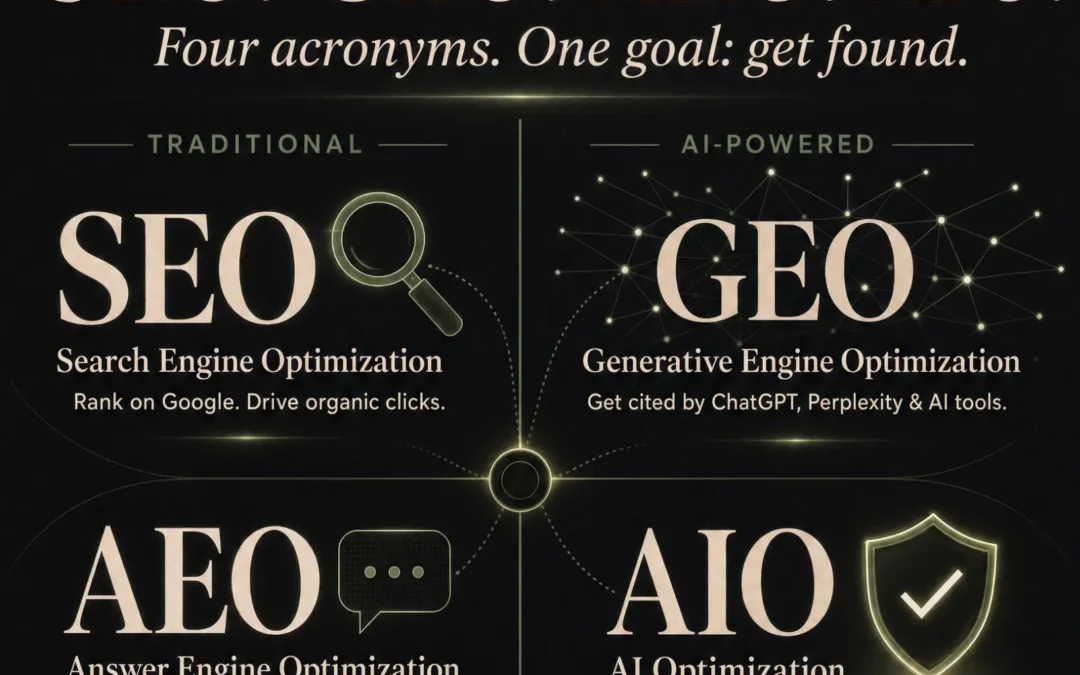
Search has fundamentally changed, and because of that, how we optimize for search has fractured into four distinct disciplines: SEO, GEO, AEO, and AIO.
If you want your business to be found in 2026, you need to understand the difference between them—and why you probably need a mix of all four.
1. SEO: Search Engine Optimization
The Goal: Rank your website on Google to drive organic clicks.
SEO is the foundation we all know. It’s the practice of optimizing your website’s technical structure, content, and backlink profile so that traditional search engines like Google and Bing rank your pages high in their organic results.
When someone searches for “plumber in Omaha,” traditional SEO is what gets your website to appear on page one. It relies on keyword research, fast load times, mobile responsiveness, and high-quality content.
Why it still matters: Despite the rise of AI, billions of traditional searches happen every day. People still want to browse options, read reviews, and click through to actual websites before making a purchasing decision.
2. GEO: Generative Engine Optimization
The Goal: Get your content cited as a source by generative AI tools like ChatGPT and Perplexity.
Where SEO focuses on traditional search algorithms, GEO focuses on Large Language Models (LLMs). When a user asks ChatGPT, “What are the best marketing strategies for a roofing company?”, the AI generates a conversational response based on its training data and real-time web browsing.
GEO is the practice of structuring your content so that these AI tools easily understand it, extract it, and—most importantly—cite your business as the source.
How it works: AI models love structure. To win at GEO, you need clear headings, bulleted lists, “Key Takeaways” sections, and direct answers to complex questions. It’s less about keyword density and more about semantic clarity and depth of expertise.
3. AEO: Answer Engine Optimization
The Goal: Become the definitive, direct answer to a user’s question.
AEO is a subset of search optimization focused on zero-click searches and voice assistants (like Siri or Alexa). When someone asks their phone, “How much does a new roof cost?”, they don’t want a list of ten blue links. They want a single, direct answer read back to them.
AEO is also what drives Google’s Featured Snippets—that box at the top of the search results that directly answers your question so you don’t even have to click a link.
How it works: To win at AEO, you need robust FAQ pages, Q&A formatting, and schema markup (code that helps search engines understand the context of your data). You have to anticipate the exact questions your customers are asking and answer them concisely.
4. AIO: Artificial Intelligence Optimization
The Goal: Build brand trust and authority across the entire AI ecosystem.
If GEO is about getting your specific blog post cited by an AI, AIO is the macro-level strategy. AIO looks at your entire digital footprint to ensure AI systems trust your business enough to recommend it.
When a user asks an AI, “Who is the most reliable landscaper in my area?”, the AI doesn’t just look at your website. It analyzes your Google Business Profile, your Yelp reviews, mentions of your brand on Reddit, and the overall sentiment of how people talk about you online.
How it works: AIO is essentially reputation management for the AI age. You optimize for it by ensuring your business information is identical across the web, actively managing customer reviews, and building a brand that real humans talk positively about online.
The Verdict: Which One Do You Need?
The truth is, you don’t need to pick just one. They are all interconnected pieces of a modern digital strategy.
- If you have a great website but terrible reviews, AIO will fail you.
- If you have great answers but poor technical structure, AEO will fail you.
- If you write for AI but ignore human search intent, SEO will fail you.
How We Handle This at KreativElement
We didn’t want to just talk about these shifts—we wanted to build for them.
On the SEO side, we built our own proprietary on-page optimization tool. It’s not a third-party plugin or a generic audit checklist. It’s a platform we developed in-house that gives our team real-time visibility into every on-page factor that matters for our clients’ rankings—title tags, content structure, internal linking, schema, page speed, the works. We built it because nothing on the market did exactly what we needed it to do for the volume and variety of clients we manage.
On the AI visibility side, we’ve partnered with Alli AI to make it possible for our clients to get found across all areas of AI—not just traditional search. Alli gives us the infrastructure to scale AI optimization across entire sites, automate the technical implementation, and ensure our clients’ content is structured in a way that generative engines, answer engines, and AI recommendation systems can actually parse and surface.
The combination of our proprietary SEO tool and the Alli AI partnership means we’re covering the full spectrum: traditional search rankings, featured snippets, voice answers, AI citations, and AI recommendations. That’s SEO, GEO, AEO, and AIO under one roof.
The acronyms might change, but the goal remains the same: get your business in front of the right people at the exact moment they need you.
References
- [1] Hibu. “SEO vs GEO vs AEO vs AIO: How They Differ.” Jan 30, 2026.
- [2] Wikipedia. “Generative engine optimization.”
- [3] Profound. “AEO vs. GEO: Why they’re the same thing.” Jun 29, 2025.
At KreativElement, we don’t just talk about SEO, GEO, AEO, and AIO—we build the systems to execute all four for our clients. If you want your business showing up everywhere your customers are searching, we should talk. Let’s connect.